Best Email Verification API in 2026: ZeroBounce, NeverBounce, Kickbox, or One Call on Monid?
ZeroBounce, NeverBounce, Kickbox, Bouncer, a DIY SMTP check and Strale compared: credit packs versus one metered per-call endpoint.

The best email verification API is the one that matches how your addresses arrive, not the one with the lowest sticker price. Scrubbing a purchased list of millions once a quarter and checking one address the moment an agent finds it are different jobs, and the tools that win at each are different tools.
Disclosure before anything else: you are on the Monid blog, so one of the options below is ours. Several of the others beat it at the job they were built for, and this guide says which and why. If you finish it and buy ZeroBounce, that is a correct outcome.
How do I deal with high bounce rates and spam traps?
Verify before you send, and understand that verification catches bounces but only partly catches traps. Those are two different problems and conflating them is what makes people distrust verifiers.
Hard bounces are addresses that do not exist: typos, departed employees, dead domains. A verifier catches these well, because they are checkable facts. Syntax parses or it does not. The domain has MX records or it does not.
Spam traps are addresses that do exist and are monitored to catch senders who did not earn their list. A recycled trap is an abandoned real mailbox reactivated as a trap; a pristine trap was never a real person at all. Both accept mail. A verifier that only checks deliverability will call them valid, because they are.
So verification is necessary and not sufficient. What actually reduces trap hits is list hygiene: never mail a purchased list, drop addresses that have not engaged in months rather than re-mailing them, and gate signups at capture so bad addresses never enter. That last one is where a per-address check earns its keep, and it is the difference between cleaning a list and never dirtying it.
The one signal a verifier gives you that is genuinely trap-adjacent is the role-address flag. info@, sales@ and admin@ are disproportionately represented among traps and are rarely worth mailing anyway.
Is there an email lookup API that reduces bounce rates?
Yes, several, and they differ mostly in how you buy them rather than what they check. Here is the field.
| Option | Full validity + reason code? | Deliverability (SPF/DKIM/DMARC)? | Billing shape | Setup and upkeep | Best for |
|---|---|---|---|---|---|
| ZeroBounce | Yes, detailed status codes | Yes, separate domain tools | Subscription or credit packs, minimum purchase | Low, dashboard plus API | Big periodic list cleans, marketers who want a UI |
| NeverBounce | Yes, clear result categories | Limited, mailbox-focused | Pay-as-you-go credits, expiry clock | Low, dashboard plus API | Pre-send bulk cleaning with no commitment |
| Kickbox | Yes, with a sendability score | Partial, deliverability tooling | Credits, volume tiers | Low, dashboard plus API | Deliverability-conscious senders, ESP integrations |
| Bouncer or Emailable | Yes, standard categories | Partial | Credits or subscription | Low, dashboard plus API | GDPR-conscious EU teams, batch plus API |
| DIY SMTP / MX check | Partial, you build the logic | Only if you write it | Free code, paid in server and IP reputation | High, ongoing | Engineers who want zero vendors and accept the risk |
| Strale on Monid | Yes: syntax, MX, disposable, role, typo | Yes, separate deliverability endpoint | Per call, shared balance, no minimum | Low, one integration | Agents, spiky or low volume, one check inside a bigger pipeline |
None of these rows is a loser. They are shaped for different jobs.
The dedicated verifiers are better at bulk than we are
ZeroBounce is the full-suite option: validation plus domain checks, activity data, a scoring model, and a dashboard where a marketer drags in a CSV and downloads a clean file. Billing is a monthly subscription with a bundled allotment, or pay-as-you-go packs with a minimum purchase that get cheaper as they grow. Purchased pack credits are generous about not expiring; a subscription allotment you do not burn does not fully carry, so over-sizing the plan quietly wastes money.
NeverBounce is the lean pay-as-you-go option, no commitment, volume tiers that drop the unit price. The tradeoff runs the other way: credits carry an expiry clock, so stocking up far ahead of a campaign puts a timer on your balance.
Kickbox leans into deliverability and sender reputation, returning a sendability signal rather than only a valid flag. If your pain is inbox placement more than list size, look here.
Bouncer and Emailable are solid API-plus-batch verifiers, with Bouncer leaning into EU data-protection positioning. If GDPR paperwork matters to your buyer, that is a real reason to shortlist it.
The honest shared trait: your money becomes a single-purpose balance that only ever buys email checks. Fine when email cleaning is the whole job, friction when it is one step inside something larger.
The DIY route costs more than it looks
You can skip vendors: parse for RFC 5322 syntax, look up MX records, optionally open an SMTP conversation to probe the mailbox. The libraries are free and the logic is not exotic.
Teams abandon it for upkeep, not difficulty. Live SMTP probing from your own IPs teaches mailbox providers to distrust that IP, quietly poisoning the sender reputation you were protecting. Catch-all domains accept everything, so a naive probe returns false confidence. Disposable-domain lists and role patterns rot. You end up maintaining a small verification product as a side quest.
What one metered call returns
strale /x402/email-validate is the per-address check. We ran it against a deliberately mistyped address on 2026-08-12:
monid inspect -p api.strale.io -e /x402/email-validate
monid run -p api.strale.io -e /x402/email-validate \
  --query '{"email":"jane@gmial.com"}'
It came back in 20 milliseconds with the verdict and the reason:
{
  "valid": false,
  "format_valid": true,
  "domain": "gmial.com",
  "has_mx_records": false,
  "is_disposable": true,
  "is_role_address": false,
  "did_you_mean": "jane@gmail.com"
}
format_valid: true with valid: false is the useful shape: the address is well-formed and still undeliverable, which is exactly the case a regex would wave through. did_you_mean is the field that saves real leads, because a typo caught at capture is a prospect you keep rather than a bounce you record.
The charge matched the listed price to the fourth decimal. Worth saying plainly, because two other endpoints we measured the same day did not.
Give this to your agent
Set up https://sandbox.monid.ai/SKILL.md, and then use Monid to show me what I can do for People Enrichment.That is the same call behind the capture-time pattern in verify an email before it hits your list. When the question is about the domain rather than one mailbox, /x402/email-deliverability-check inspects SPF, DKIM, DMARC, MX and blacklist posture.
How do I enrich a list when all I have is email addresses?
Different job, different endpoint, and worth separating because "verify" and "enrich" get conflated constantly.
Verification estimates how likely mail is to arrive. Enrichment answers who is behind the address: name, title, company, seniority, LinkedIn profile. A verifier will not tell you that no matter how good it is, and an enrichment call will happily return a rich profile for an address that bounces.
For email-to-person, pdl /v5/person/enrich takes an email among its identifiers and returns the person record. apollo /people/match does the comparable job. Both are billed per call and cost meaningfully more than a verification check, which is the correct signal: you are buying a matched record from a maintained dataset, not a DNS lookup.
The sensible order is verify first, enrich second. Verification is roughly an order of magnitude cheaper, so filtering the dead addresses before you pay for enrichment on them is the single easiest saving in this pipeline. Enriching a list you have not verified means paying premium rates to learn about people you cannot reach.
Which one should you actually use?
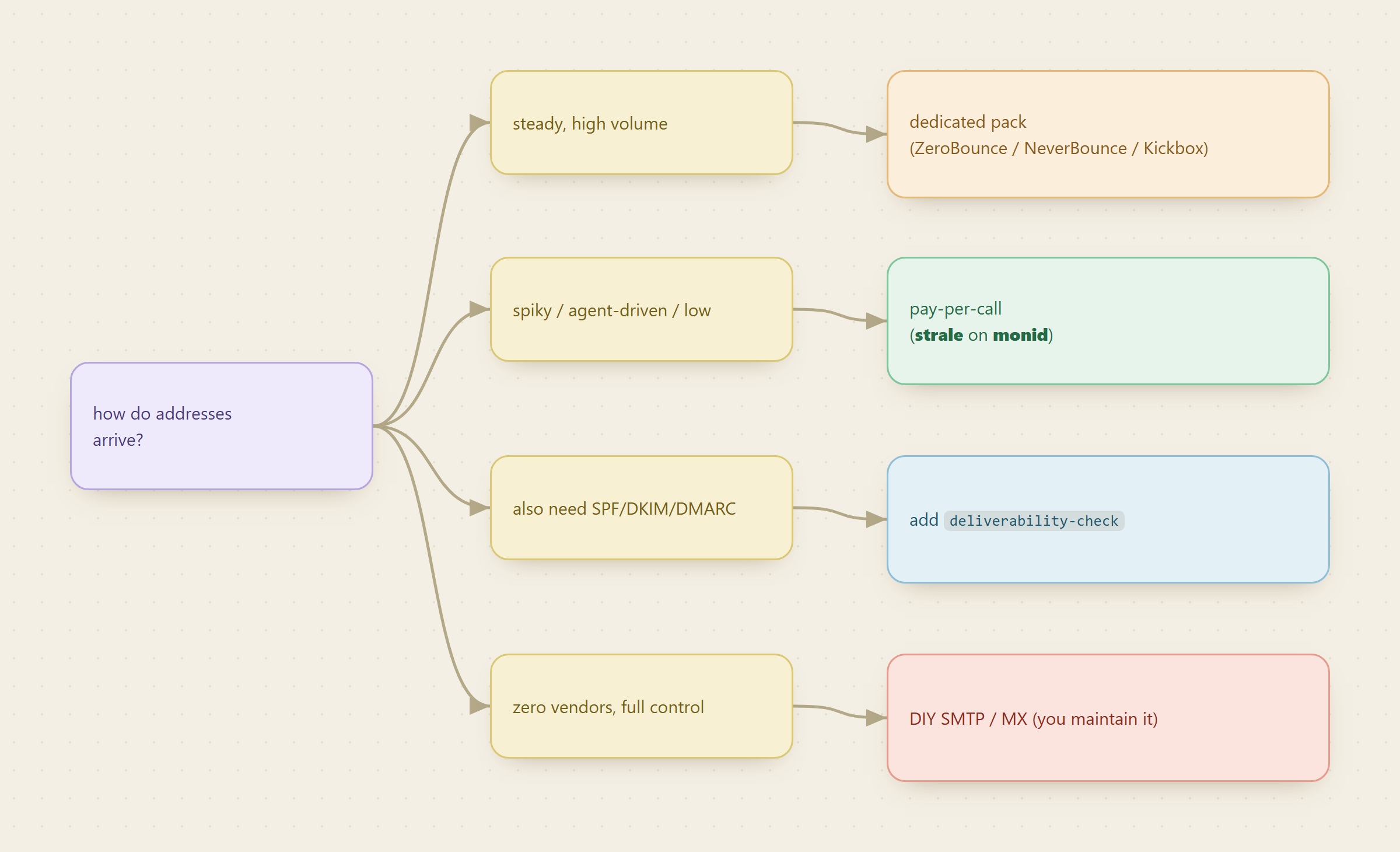
Decide on how the addresses arrive, because that is what the billing shape has to match.
They arrive in a list. A quarterly scrub of a purchased or aging database is precisely what the dedicated verifiers were built for. Buy credits, get a lower unit price than any metered endpoint, use the dashboard, done. If this is your shape, stop reading and pick from the four above.
They arrive one at a time. A signup form, a form-fill, an agent that just found a prospect. Here a credit pack is the wrong instrument: you pre-buy a single-purpose balance and hold it against demand you cannot forecast. A per-call endpoint costs nothing in a quiet week.
They arrive inside something bigger. If verification is step three of a pipeline that also pulls company data and enriches a profile, running it on the same balance as those calls removes a vendor account rather than adding one. That is the case where a marketplace wins on operations rather than on price per check.
You are an agent. An agent that can discover an endpoint, read its schema and see the price before spending can add verification to a workflow it was not built for. A credit pack cannot be discovered.
When should you not use Monid?
You clean big lists on a schedule. Per-unit, a dedicated verifier's volume tier beats a metered call, and it is not close at millions of addresses. Buy the credits.
You want a dashboard for a non-engineer. Every dedicated verifier ships one. We ship an API and a CLI. If the person doing this work drags a CSV, give them the CSV tool.
You need contractual accuracy guarantees. The verifiers publish accuracy rates and will sign paper. A marketplace optimises for breadth and switching cost.
And the caution about us: the Strale endpoints do not carry the verified badge that the first-party providers in the catalogue do, and the checks are algorithmic and DNS-based rather than an SMTP conversation. That is the right tradeoff for capture-time gating, where speed and not poisoning your IP matter most, and it is a weaker instrument than a full verifier's probe on a list you are about to mail in bulk. Run both against fifty known addresses before you trust either with a send.
Conclusion
There is no best email verification API, only a right one for how addresses reach you. Lists want credit packs. Trickles want metered calls. The mistake that costs money is buying the shape that matches your ambitions rather than your traffic.
Two things matter more than the pick. Verification catches bounces but not spam traps, so it is one part of list hygiene rather than a substitute for it. And verification is not enrichment: check deliverability first at a tenth the price, then pay to learn who is behind the addresses that survived.
Start with the free part: monid discover -q "email" shows what exists and monid inspect prints each schema and price without spending anything. One real call on an address you already know the answer for tells you more than any comparison table, including this one. Begin at monid.ai.
FAQ
Does email verification stop spam traps?
Partly. Pristine traps were never real mailboxes and recycled traps are real ones that still accept mail, so a deliverability check calls both valid. The role-address flag is the closest thing to a trap signal a verifier gives you. Real protection is hygiene: never mail purchased lists, and drop long-unengaged addresses instead of re-mailing them.
Can I just write the SMTP check myself?
You can, and the code is the easy part. What you are taking on is the reputation cost of probing from your own IPs, catch-all domains that accept everything and return false confidence, and disposable-domain lists that rot. Do it when you have an engineer who wants zero external dependencies and will own that forever.
What is the difference between verification and enrichment?
Verification estimates how likely mail is to arrive; it does not guarantee it. Enrichment asks who the person is. They are separate endpoints at roughly an order of magnitude different price, and running them in that order is the cheapest way to work.
How fast is a per-address check?
The one call we measured returned in 20 milliseconds. That is a single observation, not a percentile, and it is not enough to design a signup flow around: you would want a p95 and p99 from your own traffic before deciding. If you do put a check inline at capture, give it a short timeout, around 300ms, and a defined fallback: accept the address unverified and queue it for a background check rather than blocking the signup. A gate that can fail a registration when a vendor is slow is worse than no gate.
Last updated August 2026.