The Best Amazon Reviews API in 2026 (We Tested Them)
There is no official Amazon reviews API. Here are the real ways to get review text, what all of them costs, and the pagination limit nobody mentions.
We have pulled a lot of Amazon reviews. For competitor research, for sentiment dashboards, for agents that read the one-star reviews before a buyer commits. Every time, the first question is the same, and the second one is the one that actually costs people money.
The first is whether there is an official Amazon reviews API. There is not. The second is how to get all of a product's reviews rather than the first ten, and that one has a specific answer with a specific price, which we measured rather than repeated. Monid is the OpenRouter for agent tools, so we resell most of the options below rather than being one of them.
Fair disclosure: you are on the Monid blog, and one of the options here is ours. The correction in the pricing section below is to our own previously published claim, which was wrong.
Why is there no official Amazon reviews API?
Because the official API was built for affiliates, not for anyone who wants to read what buyers wrote.
Amazon's Product Advertising API exposed a CustomerReviews field that returned the star rating and the review count, then handed you an iframe for the rest. No documented version of it has ever returned review text, and access required an Amazon Associates account with recent qualifying sales. It was retired in May 2026, which removed even the rating badge.
The frustration this produces is easy to find. One request thread titled simply "Amazon, Market API please!" drew 149 comments. Another developer's post is a summary of the whole situation in its title: Amazon denied their API access, so they built their own scraper and published it as a library.
So every option that returns the text of a review is a scraper. The real questions are which one, how you pay, and whether it can reach past the first page.
There is no official Amazon reviews API. Everything that returns the actual text of a review is a scraper, so the only real questions are which one, and how you pay.
What is the best API to get all Amazon reviews, not just the first ten?
Any of them, if you set the page limit. The reason this question keeps getting asked is that the default is one page, and one page is ten reviews.
Here is the mechanic, measured rather than quoted. Amazon paginates reviews at ten per page, and the review endpoints expose a maxPages parameter that most quickstarts leave at 1. Set it and you get the rest.
What one real call returned
We ran apify /axesso_data/amazon-reviews-scraper against a MacBook Pro listing on 2026-08-12:
monid inspect -p apify -e /axesso_data/amazon-reviews-scraper
monid run -p apify -e /axesso_data/amazon-reviews-scraper \
  -i '{"input":[{"asin":"B0BSHF7WHW","domainCode":"com","maxPages":5,"sortBy":"recent"}]}'
It returned 50 review records across pages 1 to 5, ten per page, each carrying the full text, the star rating, the date, the reviewer name, helpful votes, attached media and a verified flag. Of the 50, 47 were verified purchases. The response also carried countReviews: 91, which is how you know when to stop: that product has 91 reviews, so maxPages: 10 would have taken all of them.
That field is the answer to the question. You do not have to guess how deep to go. The first page tells you the total, and you page until you reach it.
The correction
The previous version of this article said one ASIN query bills as a single result. That was wrong, and the measured run is how we found out. The endpoint's own price metadata says the same thing ("one result is returned per input query"), and it is also wrong.
The charge came to exactly fifty times the per-result price, one unit for each review returned rather than one for the query. Billing is per review. Practically:
- Ten reviews cost ten results. Ninety-one reviews cost ninety-one results.
- Raising
maxPagesraises the bill proportionally. It is not a free flag. - Pulling a product's entire review history is still cents, not dollars, but it is not the flat price a single query implies.
We would rather correct this in public than leave a number up that under-quotes what a job costs. It is also a caution about this whole category: the price metadata on a marketplace endpoint describes the vendor's intent, and a real run describes the bill. Run one small call before you size a batch.
Where the ceiling sits is provider specific
One thing the maxPages answer hides: not every provider reaches the same depth, and the difference comes from how they read the page rather than from how good they are.
Amazon now requires a logged-in session to load reviews beyond the first page. A provider reading the public product page sees what Amazon shows a logged-out visitor, which is a handful of reviews, and going deeper means carrying a session. OpenWeb Ninja documents this outright: their public reviews endpoint returns the eight reviews Amazon displays without a session, and the deeper endpoints take a cookie parameter holding a logged-in one. The Axesso endpoint measured above paginates past that ceiling because it reaches the data differently, which is why the run returned fifty.
The point is not that one is better. It is that "gets all the reviews" means different things depending on the route, so check the route before you size a job. A vendor that writes its ceiling into the docs is easier to build against than one that implies there is none, because you find out at design time instead of when a batch quietly comes back short.
Give this to your agent
Set up https://sandbox.monid.ai/SKILL.md, and then use Monid to show me what I can do for Amazon.Is a managed scraping API worth it, or should I build in house?
Buy it, unless scraping is the product you sell.
This is one of the most-asked questions in the category and the honest answer depends on one thing: whether the maintenance lands on someone whose job it is. Amazon is among the hardest scrape targets on the web. Rolling your own means proxies, CAPTCHAs, a login wall, and a parser you rewrite on Amazon's schedule rather than yours. You also build the verified-purchase flag, the star and keyword filters and the regional support yourself, then keep all of them working.
The marginal cost of your own scraper is near zero and its fixed cost is an engineer who gets paged during launches. At the volumes most teams actually run, a few hundred to a few thousand reviews when a project calls for it, the managed route is cheaper across a quarter even when its unit price looks higher on paper.
Build it yourself when scraping infrastructure is your core competency, or when the pipeline is the thing you are learning. Buy it when the reviews are.
The fields a review record should return
A star rating tells you a product is a 4.7. The fields below tell you why the one-stars are one-stars, and which of them to trust.
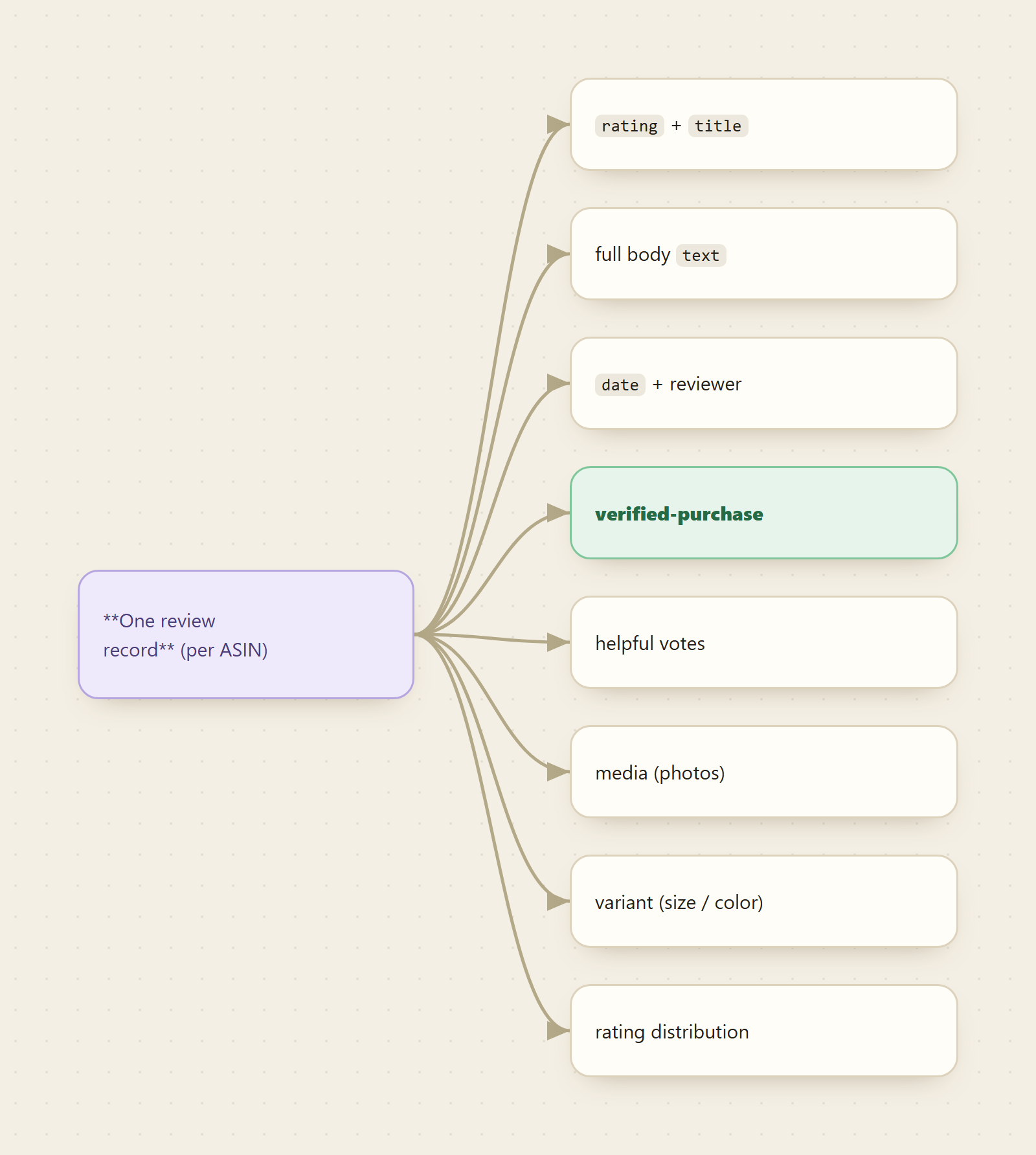
Full text and rating are the obvious ones. The verified-purchase flag is what separates signal from noise, since a review tied to a real order outweighs an anonymous one. Helpful votes let you sort by what other buyers found useful. Attached media matters more than teams expect: a photo of a cracked unit is a support signal a text-only sentiment model will miss. Variant association tells you whether the complaint was about the blue XL or the red small. The aggregated distribution gives you the shape of sentiment in one number set, so you know whether the one-stars are a rounding error or a pattern.
One texture worth knowing before you build on the text: the most recent review in our run was written in Spanish, on amazon.com. Storefront does not mean language. If you are scoring sentiment, detect the language first or your model will quietly mark what it cannot read.
Which endpoint should I use for which job?
| Option | What it does | Best for | Billing |
|---|---|---|---|
apify /axesso_data/amazon-reviews-scraper | ASIN to full review records, paginated | Most review work | Per review |
apify /web_wanderer/amazon-reviews-extractor | Same job, 20+ regional domains, aspect sentiment | Non-US storefronts | Per result |
strale /product-reviews-extract | Any review page, with a ready summary | One-off, mixed sources | Per call |
| Rainforest API | Managed Amazon data at scale | Heavy, steady daily volume | Subscription |
| Oxylabs | Enterprise scraping with SLAs | Contracts and support | Subscription |
| Build your own | Everything, including the pager | Scraping-native teams | Infra plus engineer time |
Schemas and prices verified 2026-08-12 with monid inspect, which is free to run and prints the current figure. Live per-endpoint pricing is at monid.ai/tools.
The redundancy is worth one line. With a single vendor, a broken scraper is your outage and you wait. Here the same job usually has more than one endpoint, so if Axesso has a bad day the web_wanderer extractor covers the same ASIN from the same balance with one flag change, no new signup and no new invoice.
What does pulling reviews actually cost?
Cost here is less about a unit price than about which thing gets counted, which is exactly what we got wrong above.
Work it from the shape rather than a unit price. Fifty reviews bill as fifty results, so one product's full history of about a hundred reviews is a small fraction of a dollar. A competitor teardown across twenty of a rival's best-sellers is single-digit dollars. A sentiment backfill over five hundred products with a hundred reviews each lands in the tens of dollars, not the hundreds, and it is a one-time spend rather than a plan you keep paying for. Current per-endpoint figures are at monid.ai/tools.
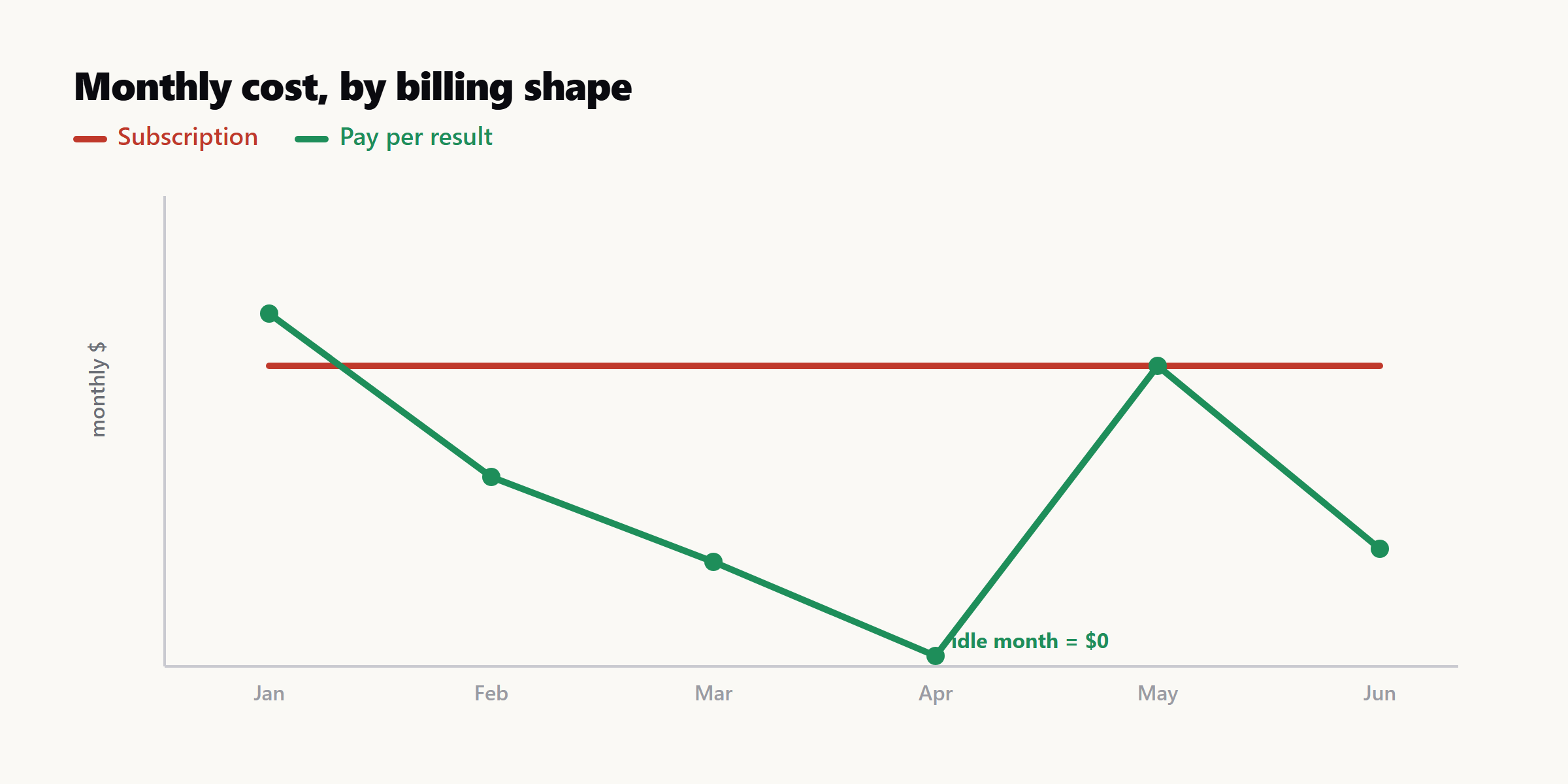
A subscription is a flat line: you pay it whether you pulled a million reviews or none, which only pencils out if your usage is high and steady enough to fill it. Per-review pricing tracks the work and drops to zero in an idle month. Building your own has almost no marginal cost and a large fixed cost that never appears on an invoice.
For most teams, whose review work arrives in bursts around launches and teardowns, the metered shape is cheaper across a full quarter even when its unit price looks worse. But size it from a real run, not from the endpoint's description.
When should you not use Monid?
Three honest cases, and one caution about us.
You only need a rating and a count. No scraper is worth it for a star badge, though note that the free official route for this is now gone.
Your volume is genuinely enormous and steady. Millions of reviews a day on a fixed schedule is where a dedicated contract with Rainforest or Oxylabs beats metered pricing on raw unit cost, and where an SLA is worth paying for. Price it out rather than assuming either way.
You need a guarantee, not a catalog. A marketplace optimises for breadth and switching cost. If you need a named account manager and a contractual uptime number, buy direct.
And the caution: the pricing metadata on these endpoints can be wrong, as this article's own correction shows. monid inspect is free and tells you the schema and the stated price, but the stated price is the vendor's description of their billing, not a measurement of it. On any endpoint you are about to run at scale, do one small run first and read the actual charge.
Conclusion
The best Amazon reviews API is whichever one you point at the right page depth, because the thing that usually goes wrong is not the vendor, it is the default. maxPages at 1 gives you ten reviews and the impression that the API is limited. countReviews in the first response tells you how far to go.
Two things matter more than the choice between vendors. The first is that you are paying per review, not per product, so the page limit is a spending dial and should be set deliberately. The second is that endpoint metadata is a description and a run is a measurement: this article said the wrong thing for a month because we trusted the former, and one call for seven cents settled it.
Start with the free part. monid discover -q "amazon reviews" shows what exists and monid inspect prints the schema and stated price without spending anything. Then run one small call and read the charge. Begin at monid.ai.
FAQ
How can I scrape only price, stock and availability from Amazon every day?
Use a product endpoint rather than a reviews one, and pull only the ASINs you actually track. The reviews scrapers above return the review body, which is the expensive part of the payload and pointless if you only want a number that changed. A daily price and stock check is a small, scheduled job whose cost scales with how many ASINs you watch, not with how much text comes back.
How do I connect Claude to Amazon keyword and competitor sales data?
Give the agent an endpoint it can discover and inspect on its own rather than hardcoding a vendor SDK. That is what the set up https://monid.ai/SKILL.md line does: the agent lists what exists, reads a schema, sees the price before it spends, and can pick a different endpoint if the first one does not fit. Sales figures specifically are estimates from third-party data, never Amazon's own numbers, and should be treated as directional.
What is the best API for Amazon product data, as opposed to reviews?
Different endpoint, same marketplace. Product detail calls return title, price, availability, images and variants, and are usually billed per call rather than per review because the payload is one object rather than a list. Run monid discover -q "amazon product" to see the current set.
Can I get reviews from Amazon outside the US?
Yes. domainCode selects the storefront, and web_wanderer/amazon-reviews-extractor reaches 20+ regional domains, so UK, German and Japanese listings come through the same call. Remember the language point above: a storefront's reviews are not all in that storefront's language.
Last updated August 2026.