The Real Cost of Scraping YouTube Yourself
Build-your-own YouTube scraping versus a pay-per-call endpoint: why the true DIY cost is maintenance and breakage, not code.
Copy this line to your agent to pull a YouTube channel's recent videos without touching yt-dlp.
set up https://monid.ai/SKILL.md and use tikhub /api/v1/youtube/web_v2/get_channel_videos to list a YouTube channel's recent videos
The cheapest way to scrape YouTube is usually not to scrape it yourself. The code to grab a channel's video list is easy to write and easy to demo. What costs you is the second month, when a silent layout change returns empty results, a proxy pool gets flagged, or your daily quota runs dry mid-job. For most teams the honest all-in price of do-it-yourself is engineer hours, not compute, and that is exactly the line item a pay-per-call endpoint erases.
TL;DR
- DIY scraping with yt-dlp plus proxies is free to start and expensive to keep alive. YouTube breaks extractors often, and a stale install is the number one reason a working script suddenly returns nothing (roundproxies).
- The official YouTube Data API is the correct choice for owned-channel analytics and strict terms-of-service compliance, but it ships a fixed daily quota that a search-heavy workload burns through fast (Phyllo).
- A pay-per-call TikHub endpoint on Monid turns the whole problem into one billed call: no proxies, no OAuth project, no parser to babysit. You pay a fraction of a cent per call, only when a call runs.
- Decide on the job, not the logo: owned-channel or ToS-strict points to the official API, everything else at any real volume points to pay-per-call.
📖 See also the same question asked about Reddit, where the build-versus-buy maths lands differently.
What DIY actually charges you
Rolling your own starts with a well-loved tool. yt-dlp extracts video metadata, and a headless browser plus a rotating proxy pool can walk a channel page. The demo works in an afternoon. Then the bill arrives in installments.
YouTube changes its internal page structure and anti-bot measures on its own schedule, and when it does, extractors break until someone ships a patch. The practical field advice is blunt: whatever you build today can break within six months, so you write defensive parsers, log failures loudly, and watch the yt-dlp issue tracker before debugging your own code (roundproxies). At AI scale the same tool needs proxy rotation and constant version bumps just to keep returning data (DataBeacon on Medium).
Add it up honestly. Proxies are a recurring subscription. The extractor is a maintenance contract you signed with yourself. Every layout break is an unplanned interruption that pulls an engineer off roadmap work to reverse-engineer a page. None of that shows up in the code review, which is why DIY looks cheap right up until it isn't.
Where the official Data API fits
Google's YouTube Data API v3 is legitimate, stable, and the right answer for a real set of jobs. If you own the channel and need first-party analytics, or your compliance posture requires staying inside official terms, use it. That is the honest caveat in this whole comparison, and it matters.
The friction is twofold. First, setup: you create a Google Cloud project, enable the API, and wire up OAuth or an API key before your first call. Second, quota. Every project gets a default daily allowance of 10,000 units that resets at midnight Pacific time, and each operation has a unit cost. A cheap read costs a single unit, but a search request costs 100 units, so a search-driven workload can drain the day's budget in roughly 100 calls (ChannelCrawler). Past that ceiling the API returns 403 quotaExceeded for the rest of the day (Phyllo). Higher limits are free to request but granted on merit, not on demand. For broad discovery across channels you do not own, the quota wall arrives sooner than most teams expect.
The pay-per-call option
Monid is the OpenRouter for agent tools: one interface and one balance to discover and run over a thousand tools without a separate signup per vendor. It ships as an MCP server, so an agent can find and call an endpoint on its own. For YouTube channel videos, the relevant endpoint is TikHub's /api/v1/youtube/web_v2/get_channel_videos, which takes a channel_id as a query parameter and paginates through a continuation_token.
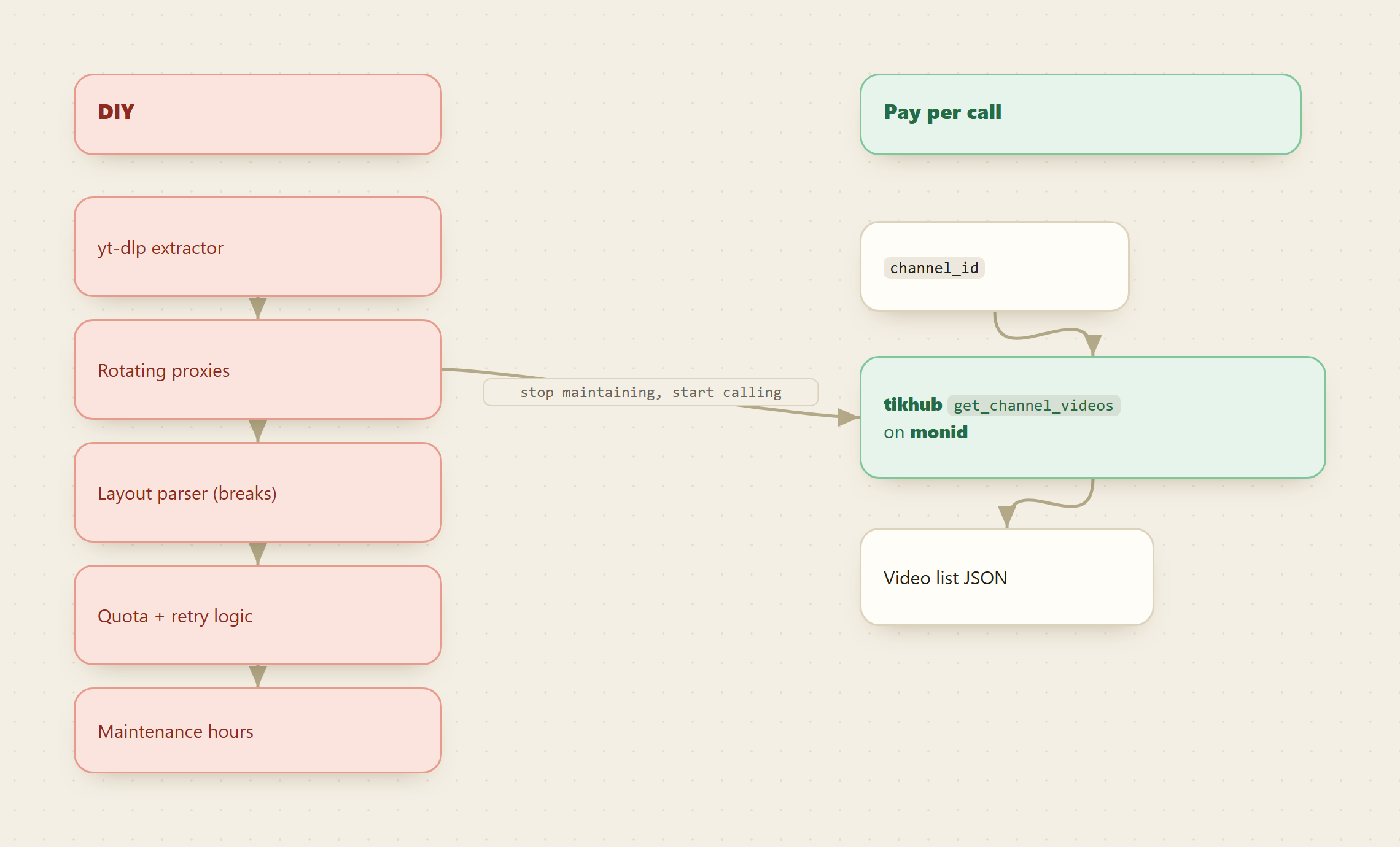
There is no project to provision, no proxy to rotate, and no parser to patch when the page shifts. The provider absorbs the breakage risk that would otherwise be your on-call rotation. You are billed only on the paid run step, at the price shown before you commit, which for this kind of read lands in the fraction-of-a-cent range. Current per-call pricing lives on monid.ai/tools.
For agents
Grab an API key at app.monid.ai, then paste this to your agent and hand it the key:
set up https://monid.ai/SKILL.md
It learns the whole discover, inspect, run workflow itself. More details in the agent quickstart.
For humans
npm install -g @monid-ai/cli
monid keys add --label main --key <your-api-key>
More details in the CLI quickstart.
One call, waiting inline for the result:
monid run -p tikhub -e /api/v1/youtube/web_v2/get_channel_videos --query '{"channel_id":"UCJHBJ7F-nAIlMGolm0Hu4vg"}' -w
Add language_code or country_code to the query JSON when you need localized results, and feed the returned continuation_token back in to page further. Discovery and inspection cost nothing, so you can confirm the exact fields before you spend.
How the three stack up
| Roll your own (yt-dlp + proxies) | Official Data API | Pay-per-call (TikHub on Monid) | |
|---|---|---|---|
| Setup | Build extractor, buy proxies | Cloud project plus OAuth or key | API key, one command |
| Ongoing spend | Proxy subscription plus engineer hours | Free within a fixed daily quota | Per call, magnitude of a fraction of a cent |
| What breaks it | YouTube layout and anti-bot changes | Hitting the daily quota wall | Provider handles it |
| Scaling | Add proxies and maintenance | Request higher quota, merit-based | Add calls, wallet-metered |
| Best for | Full control, one-off experiments | Owned-channel analytics, ToS-strict | Discovery across channels at volume |
FAQ
Is scraping YouTube with yt-dlp illegal? That is a terms-of-service and jurisdiction question, not a settled yes or no, and it is the reason the official API exists as the compliant path. If your use case is sensitive to terms, prefer the Data API. This post compares cost and reliability, not legal risk.
When is the official Data API still the better call? When you own the channel and want first-party analytics, or when compliance requires staying inside Google's terms. Its quota and OAuth setup are a fair trade for that.
How much does the pay-per-call endpoint cost?
A read like get_channel_videos sits in the fraction-of-a-cent-per-call range, billed only when the call runs. There is no monthly floor and no per-vendor signup. Live pricing is on monid.ai/tools.
Do I need to write scraping code at all with Monid? No. Discovery, inspection, and the single billed run cover it, and an agent can drive the whole loop through the MCP server after you add a key.