Google Maps Reviews Without a Places API Key
Pull full Google Maps review text for a place from one pay-per-call endpoint on Monid. No Places API key, no GCP project, no five-review cap.
Copy this line to your agent to pull a place's full Google Maps reviews.
set up https://monid.ai/SKILL.md and use apify /compass/google-maps-reviews-scraper to pull a place's full review text from Google Maps
You can get the full review text for a Google Maps place from one pay-per-call endpoint, with no Places API key and no Google Cloud project to stand up first. Monid is a pay-per-call data API marketplace: one interface and one wallet reach hundreds of external data endpoints across web scraping, enrichment, social data, and search, without a separate signup per vendor. Google Maps reviews are one of the endpoints we have verified ourselves, and this piece explains how we think about the job and why we shaped it the way we did.
TL;DR
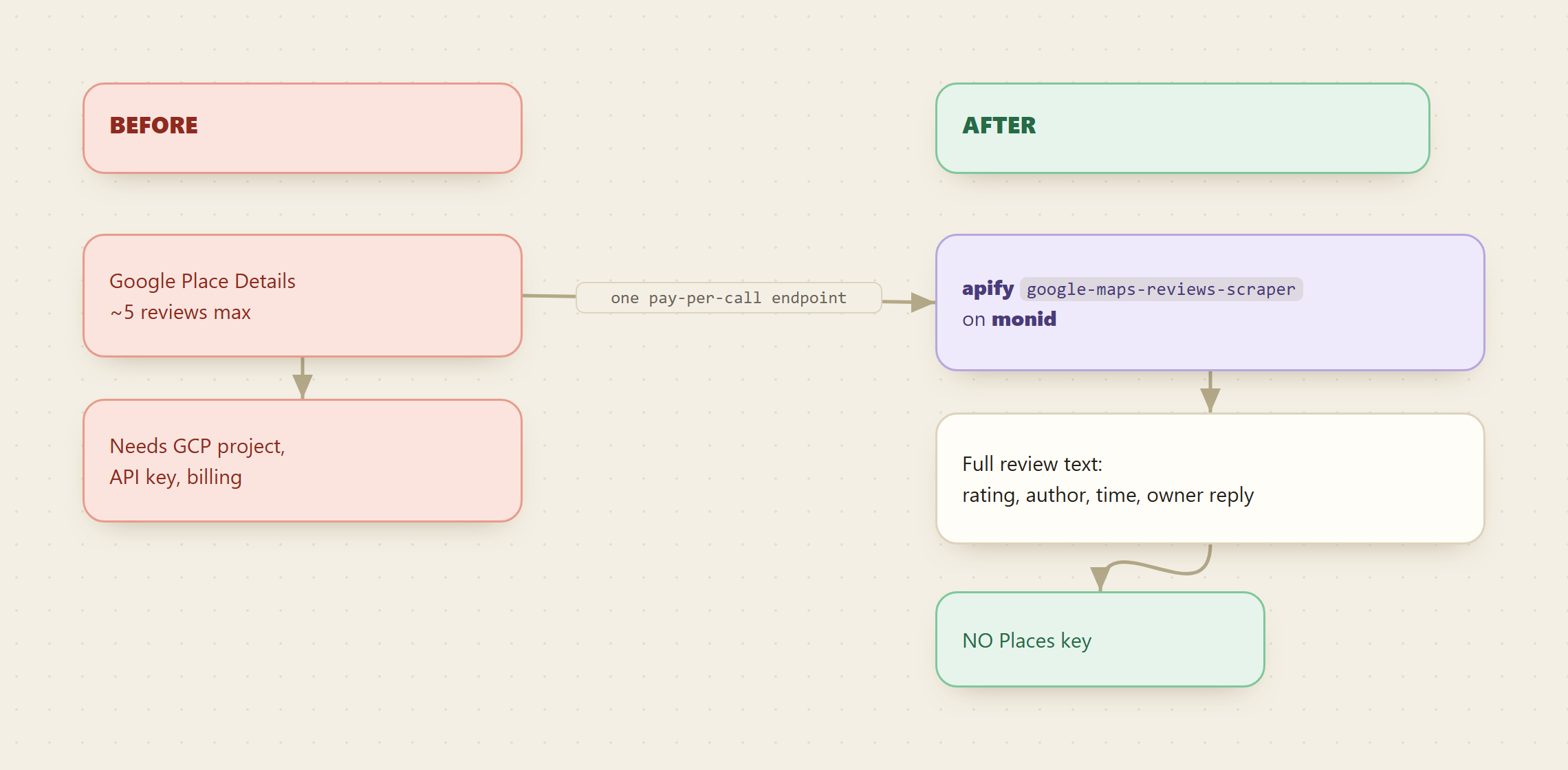
apify /compass/google-maps-reviews-scrapertakes a Maps place URL and returns per-review text, star rating, author, timestamp, and owner responses. No Google Places API key required.- Google's own Place Details endpoint caps a place at five reviews with no pagination, which is why the full text lives elsewhere.
- The run is billed per result, so cost tracks the depth you choose. The exact figure is shown before you spend. Current prices are at monid.ai/tools.
- You bring one Monid wallet instead of a GCP project, an API key, and per-vendor billing.
- Monid ships as an MCP server, so an agent can pull the reviews mid-task without you wiring a scraper first.
Why the reviews live outside the official API
It is worth being precise about the gap, because it is the reason this endpoint exists. Google's Place Details endpoint returns at most five reviews per place with no way to page past them, so anything that reads like the real voice of a location's customers was never the official API's job. Add that the Places API is key-gated, tied to a Google Cloud project, and billed against a quota you provision, and the setup cost alone outweighs the payload for a team that just wants to read what people wrote. We built toward the opposite: point at a place, get the reviews, pay for the rows you took. The principles below are how that shakes out.
1. No Places API key, no GCP project
The first thing this removes is the whole Google Cloud onboarding path. There is no project to create, no key to provision and rotate, no billing account to attach, and no per-service quota to babysit. apify /compass/google-maps-reviews-scraper, maintained by scraping specialists on Apify, takes a Maps place URL or place ID and reads the review pane directly. The provider owns the proxies and the parser upkeep. You own a single Monid balance. Inspect the schema and the price for free before anything bills:
monid inspect -p apify -e /compass/google-maps-reviews-scraper
# -> input schema, field docs, and per-result price (free)
For agents
Grab an API key at app.monid.ai, then paste this to your agent and hand it the key:
set up https://monid.ai/SKILL.md
It learns the whole discover, inspect, run workflow itself. More details in the agent quickstart.
For humans
npm install -g @monid-ai/cli
monid keys add --label main --key <your-api-key>
More details in the CLI quickstart.
2. The full review text is the payload
A star average tells you a place is a 4.3. The reviews tell you why the one-stars are one-stars. This endpoint returns each review's body text alongside its rating, the author, and the timestamp, which is the raw material the official API never hands back. Keep the first run small and let the schema confirm the shape before you scale:
monid run -p apify -e /compass/google-maps-reviews-scraper \
  -i '{"startUrls": [{"url": "https://www.google.com/maps/place/?q=place_id:ChIJ..."}],
       "maxReviews": 20, "reviewsSort": "newest", "language": "en"}'
# -> Run ID: 01HXYZ...

monid runs get -r 01HXYZ... -o reviews.json
# -> COMPLETED: review text, star rating, author, timestamp,
#    and owner responses, billed per result
Three input fields carry most of the value. maxReviews is your depth and cost dial in one. reviewsSort set to newest turns a full-history dump into a recent-first read. language returns the review in the tongue the customer wrote it, which matters when a location's reviews span a dozen of them.
3. Owner responses and rating ship in the same record
The reply matters as much as the complaint. Each record carries the owner response inline with the review it answers, so you can see not just what a location scored but whether and how fast it replied, without a second lookup or a join. The star rating rides in the same row, so a filtered pull, say the one and two-star reviews, comes back already paired with the owner's side of each. That pairing is the difference between a rating dashboard and an actual account of how a place handles its customers.
4. Per-call billing you read before you run
The run is the only paid step, and it is billed per result, so there is no tier that unlocks depth and no throttle that rations it. A twenty-row spot check on a place costs a fraction of a cent. A deep pull of a busy location's recent history lands in single-digit dollars. Because the free inspect step shows the exact per-result figure first, the cost is a line item you read before you commit, not a bill you reconcile after. Current prices for this endpoint live at monid.ai/tools, and a week with zero runs costs zero.
5. One wallet, and the agent pulls it mid-task
Because Monid is also an MCP server, none of this has to be a script you run ahead of time. An agent handed "summarize the recent one-star reviews for this place and whether the owner responded" can discover the endpoint, inspect its price, run it with a newest-first sort, and read the text back, all inside one task and against one wallet. The discover then inspect steps are free, so the agent can shop the catalog before it spends a cent.
FAQ
Do I need a Google Places API key or a Google Cloud project? No. The Apify endpoint runs without a Places key. You integrate Monid once and fund one pay-as-you-go wallet, and the provider owns the scraping infrastructure.
How many reviews can I pull for a place?
There is no fixed five-review cap here. You set maxReviews, and because billing is per result, depth is something you choose and pay for rather than a wall you hit.
What fields come back? Per-review text, star rating, author, timestamp, and owner responses, with a sort and language control on the input. Inspect the endpoint for the full schema before you run.
How much does it cost? Per result, from a fraction of a cent for a spot check to single-digit dollars for a deep pull, always shown before the run. Current prices are at monid.ai/tools.
Try it
Grab a key at app.monid.ai, inspect the endpoint for free, and pull twenty recent reviews for a place you know. If the text, ratings, and owner replies match what you see on the map, raise maxReviews and widen the pull. For agents, hand yours the SKILL file and it learns the discover, inspect, run workflow itself. Start at monid.ai.