The Best Web Search API for AI Agents in 2026
Comparing web search APIs for AI agents in 2026: Exa, plain SERP APIs like Serper and SerpAPI, Tavily, and Brave, with a clear pick.
Copy this line to your agent to give it live web search that returns readable page content in one call.
set up https://monid.ai/SKILL.md and use exa/search to search the live web and read the top sources in one call
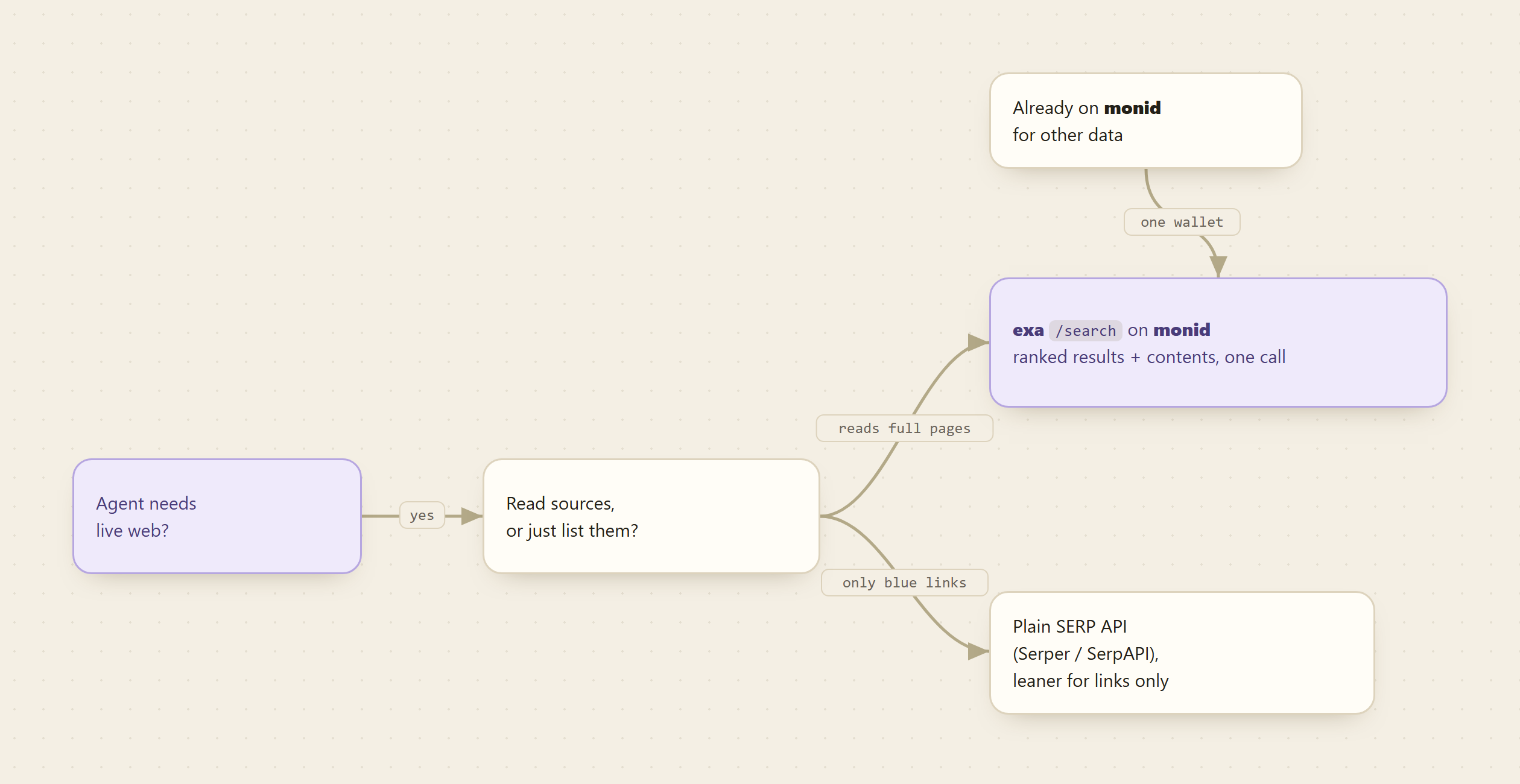
For an AI agent that has to read sources at runtime and not just list them, the best web search API in 2026 is the one that returns ranked results and the cleaned page text in a single call. Exa's /search does exactly that, and running it through Monid means it bills per call from the same balance as the rest of your scraping, enrichment, and data tools. If your agent only ever needs blue links, that is genuinely overkill, and a plain SERP API is the leaner buy. The rest of this post is the honest version of that trade.
TL;DR
- If your agent reads sources: Exa
/searchreturns ranked neural or keyword results plus cleaned page contents in one call, so retrieval and reading are one step. - If your agent only needs links: a plain SERP API (Serper, SerpAPI) is leaner and cheaper. It returns SERP JSON, and you add a scrape step only if you actually need the page body.
- Close peers exist: Tavily can return page text on
/searchvia a flag, and Brave has a separate content endpoint. Exa is not alone on the "results plus contents" idea. - The Monid tie-breaker: on Monid, Exa search sits on one balance with hundreds of other endpoints, priced pay-as-you-go, so you are not managing a fifth vendor signup.
- Watch the legal risk on scraper-based SERP providers before you standardize on one.
📖 See also the free page-extraction options for RAG, which is the step after the search returns.
The real split: search that lists versus search that reads
Every option here can hand your agent a list of relevant URLs. The line that actually matters is what happens next. An agent doing research, grounding, or RAG rarely wants ten links. It wants the text on those pages, cleaned of nav bars and cookie banners, ready to drop into a prompt.
A plain SERP API stops at the results page. Serper returns structured SERP JSON (titles, links, snippets, knowledge panels) and does not fetch the content behind those links, per its own scrape tool docs which exist precisely to add that step. SerpAPI is similar in shape: a proprietary parser that returns 15-plus Google element types as JSON, still the search results page rather than the pages it points to. To read a source, you make a second call to a scrape or extract service. Two vendors, two bills, two failure modes, and latency that stacks.
Exa collapses that. As of March 2026, Exa bundles cleaned contents for the top results into the search call itself, so one request gives you ranked results and LLM-ready page text together. Its ranking is neural or keyword, which suits the fuzzy, meaning-shaped queries agents tend to write.
The 2026 field, side by side
| Option | What one call returns | Best when | Where cost lives |
|---|---|---|---|
Exa /search on Monid | Ranked neural or keyword results plus cleaned page contents | Your agent reads sources at runtime (research, RAG, grounding) | One Monid wallet, per call |
| Serper / SerpAPI (plain SERP) | SERP JSON: titles, links, snippets, panels. Content needs a second scrape call | You need blue links or a specific SERP feature (news, shopping, PAA) | Per SERP call, plus a separate scrape vendor if you need bodies |
| Tavily | Results, plus optional full page text via include_raw_content; separate /extract too | Agent-tuned search where you want to toggle content on | Its own account and plan |
| Brave Search API | Snippets by default; full content via a separate LLM Context endpoint | Independent index, privacy posture, snippet-grade grounding | Its own account and plan |
To be fair to the field: Exa does not own the "results plus contents" idea. Tavily returns raw page text on /search when you set include_raw_content, and Brave ships an LLM Context endpoint that chunks and extracts page content. Both are credible agent search APIs. The difference on Monid is not that Exa is the only one-call reader. It is that you get one of the strongest one-call readers without adding another vendor relationship.
What a call actually costs, in magnitudes
Skip the price sheets and reason about the shape of the bill. A single plain SERP call is cheap, often a fraction of a cent per query. The trap is the second step. For a research answer that reads five sources, the two-vendor pattern is one SERP call plus five scrape or extract calls, and the scrape side is usually the pricier line. Your cost per useful answer is the sum, not the headline SERP price.
Exa search meters as one call that already carries the contents, so the per-answer math is a single line item at a few cents of magnitude depending on how many results you read. On Monid that call is pay-as-you-go at the price shown before you run it, on the same balance as everything else. You can see the current rate for Exa and every other endpoint on monid.ai/tools without a signup per vendor.
The honest caveat
Results-plus-contents is not always the right buy. If your agent genuinely needs only ranked links, or a specific SERP surface like shopping results, news clusters, "people also ask", or a local pack, a plain SERP API is leaner and cheaper, and paying for content extraction you throw away is waste. Match the tool to whether the agent reads or just routes.
One more thing worth knowing before you standardize: scraper-based SERP providers carry legal exposure. In December 2025 Google filed suit against SerpAPI over how it obtains Google results. That is not a verdict on quality, but it is a real operational risk to weigh for anything you plan to run for years.
Run Exa search on Monid
For agents
Grab an API key at app.monid.ai, then paste this to your agent and hand it the key:
set up https://monid.ai/SKILL.md
It learns the whole discover, inspect, run workflow itself. More details in the agent quickstart.
For humans
npm install -g @monid-ai/cli
monid keys add --label main --key <your-api-key>
More details in the CLI quickstart.
Then find the endpoint, read its schema for free, and run it. Only the run bills.
monid discover -q "web search"
monid inspect -p exa -e /search
monid run -p exa -e /search -i '{"query":"latest EU AI Act enforcement guidance","numResults":3,"contents":{"text":true}}' -w
That single run returns three ranked results with cleaned page text attached, which is the whole point.
FAQ
Which web search API is best for AI agents in 2026?
For agents that read sources, pick a search API that returns ranked results and cleaned page contents in one call. Exa /search is a strong default, with Tavily and Brave's content endpoint as credible peers. For link-only routing, a plain SERP API is leaner.
Do plain SERP APIs like Serper and SerpAPI return page content? No. They return the search results page as structured JSON (titles, links, snippets, panels). To read the body of a linked page you add a separate scrape or extract call.
How much does web search cost through Monid? It is pay-as-you-go at the price shown before you run, on one balance with every other endpoint. Expect a few cents of magnitude per Exa search depending on how many results you read. Current rates are on monid.ai/tools.
Why run Exa through Monid instead of directly? Same one-call search, but on a single balance and interface shared with hundreds of other data endpoints, so you skip a separate vendor signup and manage one bill. Discovering and inspecting endpoints is free; only the run is billed.